Twenty-seven-year-old Emily has lived on her family homestead with her mother, Tracy, and older brother’s family for about a year.
Read moreMEET FA'er Emily Rogez
Emily Rogez with mom, Tracy, brother Trey, and his daughters, Paisley and Hannah

Your Custom Text Here

Emily Rogez with mom, Tracy, brother Trey, and his daughters, Paisley and Hannah
Twenty-seven-year-old Emily has lived on her family homestead with her mother, Tracy, and older brother’s family for about a year.
Read moreI am Christin Haun from Broken Arrow, Oklahoma, part of the Tulsa metro area. I was diagnosed in 1985, at 14 years old, as having Friedreich's ataxia.
Read moreEighth grader Taber Elam has had quite a journey since 5th grade…
Read more
221 attendees, 25 FA families, 9 states!
5 countries & 16 states online!
Live streamed for the 3rd year
More sponsors than ever before
2022 & earlier Soirées on YouTube
youtube.com/curefasoiree
Sponsor, donate or buy tickets for 2023
give.curefasoiree.org

Heather was determined to walk across the stage unassisted to receive her diploma. After having fallen ill during Spring Break, she became more and more unsteady on her feet. Being the independent young woman she is while having had to learn to start asking for help, Heather hatched a plan so she could walk at graduation.
Read moreMy case is atypical and was detected later than normal. As an infant I experienced congestive heart failure and, at the time, it was treated solely as a heart condition. The technology to screen for genetic diseases wasn’t yet available. I developed gait and balance issues in my mid-20s. It wasn't until those were investigated that FA came to light. I was officially diagnosed when I was 31 years old.
Read more
Wes Gates, Haggie (service dog), Roger Gates (dad), Robert Beard (nephew), Joe Beard (brother-in- law), Julie Gates (mom), Marie Beard (sister), Aubrie Beard (niece)
Diagnosed at the age of 13 years old, Wes Gates, now 34, has persevered through a string of challenges courtesy of Friedreich’s Ataxia (FA). Wes’ dad, Roger, was serving in the United States Air Force at the time and it was thanks to the medical personnel at Walter Reed Army Medical Center in Washington, D.C. that Wes was tested for FA in March 2001.
FA typically causes muscles to atrophy which in turn allows the spine to bend out of shape. Because of the degenerative effects of progressive scoliosis, Wes had to undergo spinal cord fusion, a major back surgery, soon after receiving his FA diagnosis in May 2001.
Wes graduated from Fort Walton Beach High School in 2005 and decided to attend college at Northwest Missouri State University (NWMSU). Although he could still walk without assistance, Wes started using a wheelchair after he fell and broke his shoulder during the second semester of his freshman year. In 2012, after transferring to the University of Oklahoma (OU), he broke his ankle. By the time it healed, Wes had lost the ability to walk on his own. But he persevered, continuing to take classes full time at OU. At NWMSU Wes had originally wanted to be an architect, but as the FA progressed, he changed to Computer Engineering at OU. The handwriting required in the mathematics courses became impossible. After attending college off-again, on-again for eight years, Wes was ready to graduate. OU offered him the opportunity to earn a degree in Multidisciplinary Studies for which he lacked only a few humanities courses. Wes started taking film classes and fell in love with this area of study. In 2013, he graduated with a Bachelor of Science degree with an emphasis in Computer Science thanks to all his math/science credits.
For a time, Wes operated a film review website. An exciting highlight during that time was when a Major League baseball player from his favorite team, the St Louis Cardinals, followed his reviews. After a while, Wes could no longer provide reviews because typing became very difficult for him and eventually even using a voice translator stopped working because of the slurred speech pattern which is typical of FA’ers.
Since his spine surgery, Wes has suffered from chronic lower back pain and gradually became dependent on narcotic pain medication, despite only taking them as prescribed. These meds turned him into a zombie, always sleeping, and didn’t even relieve the pain; they just made him not care that he was hurting. After medical marijuana was legalized in Oklahoma, he decided to try it and applied for a license. Even with his pain doctor’s assistance with weaning himself off of the pain medications, Wes ended up in the hospital for five days while his body withdrew from the heavy amount of narcotic medication his body had become accustomed to taking for almost ten years. In the end, it was worth it because Wes can now manage his back pain more effectively with 2-3 doses of medical marijuana per day with zero narcotics. He is now more engaged and can better interact with friends and family.
Wes wakes up early, watches TV shows like Morning Joe to keep up with current events, then streams TV shows or movies to pass the day until his dad gets off work. Thanks to Christin Haun, an FA Ambassador from Broken Arrow, OK who has lived with FA for about 40 years, the Gates family found out that Wes qualified for an OK Department of Human Services (DHS) program that either provides a home aide or pays family members to provide basic care (meal preparation, grooming, house cleaning, etc). As a result, after unsuccessfully being able to find reliable providers through DHS, Wes’ parents, Roger and Julie, perform these services that a home aide would typically provide and receive financial compensation.
The Gates family converted a detached garage into private quarters with a living room, bedroom, bathroom, and small kitchen for Wes. They also turned the breezeway that once connected the garage to the main house into a room that contains an above-ground safe room for Oklahoma’s springtime ritual.
Going to the bathroom by himself had become a great source of frustration because of difficulty using a urinal. In April 2022, Wes underwent a short procedure to insert a catheter through his abdomen into his bladder. The collection bag only needs to be emptied once a day and his dad will eventually learn to change the catheter tube by himself once a month. So far the procedure has significantly increased Wes’ quality of life.
Wes’ sister, Marie, bought him a red merle border collie puppy for his birthday in July 2020 with the goal of Haggie (named after Merle Haggard, get it?) becoming a service dog in addition to a faithful companion. Because of the Covid pandemic, they had to train Haggie themselves using video teleconferencing with an obedience trainer. Haggie knows important behavioral commands and can pick up dropped items for Wes. They are currently working to train Haggie to press a panic button (Ring doorbell camera) that will automatically call if help is needed.
Thanks to Wes’ ingenuity and computer literacy, he has talked his dad through the challenges of incorporating many adaptive technologies (e.g. Amazon Alexa) in his living area to control lights, door locks, the thermostat, and cameras/temperature control for his medicinal grow tent.
Wes states, “Facing the challenges of FA has taught me to be adaptable because if you don’t adapt to the many obstacles, you’ll be miserable all the time. I do get frustrated and angry at times, such as when I drop something repeatedly. Yet, I tell myself that staying frustrated won’t help make it any easier. The current drug trials are for treatments to slow down disease progression, which is great for those just beginning the FA journey. My hope is that research will discover a treatment that can reverse my advanced progression and give me back some self reliance.”
Wes experiences renewed motivation when attending FA events. Being around others with FA, who don’t let this disease stop them and who are determined to do the best they can, reminds him that he can do the same.
“Never trust a man in a wheelchair with dirty shoes.” ~ Ron Burgundy from Anchorman: The Legend of Ron Burgundy
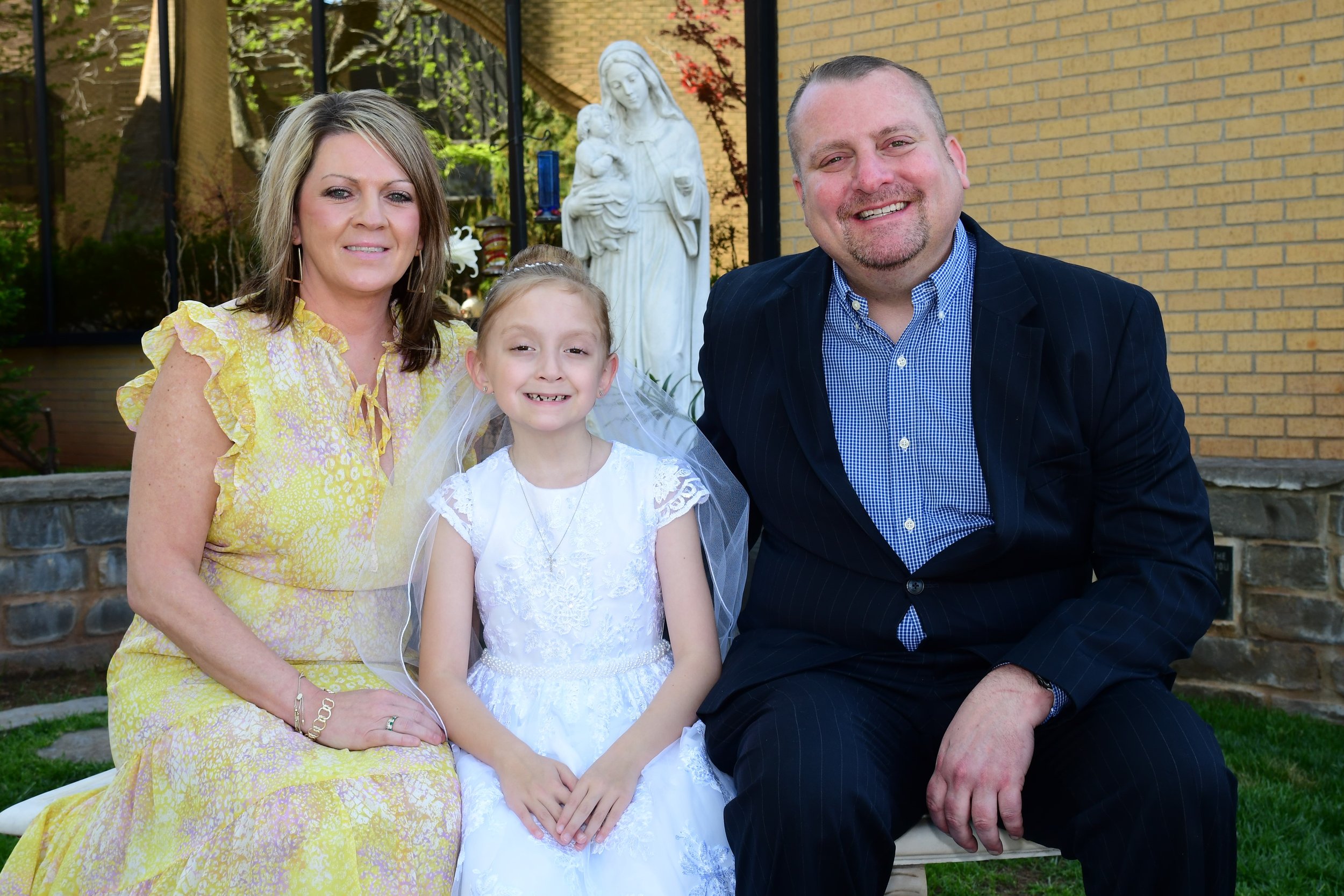
Mary, Olivia (8 yrs old), and Matt Francis
Olivia, now a 3rd grader at St. Elizabeth Ann Seton, was diagnosed with FA Feb 2020 at 6 years old. FA seems to be more critical the younger the patient. Her mother, Mary, said that she suspected something was going on when Olivia was 18 months old but, FA being a rare disease, it took a few years to eventually be referred to the Mayo Clinic and receive the diagnosis. Because of her young age, Olivia cannot qualify for clinical trials but there is hope that at some point in the not too distant future, she'll be accepted into one. Mary stays informed via clinicaltrials.gov and through FARA's app.
Mary and Matt encourage Olivia to pursue her interests and not let FA limit her. They try not to be too hypersensitive while still being vigilant for Olivia’s welfare. At school, Olivia has permission to now take the elevator but she continues to take the stairs with the help of friends and faculty who have known her since she was 18 months old. Because her hand tires more, the school now allows Olivia to get help with handwriting her homework.
The wheelchair is now Olivia’s main mode of transportation when visiting the zoo due to the grounds being so large. Yet nothing will keep Olivia from her dance classes. Her love of ballet is more than just a passing fancy. The Nutcracker has been her favorite ballet since first seeing it at the age of four years old. Her mother, Mary, says she was mesmerized. She now attends the ballet as often as possible. Since starting classes at two years old, Olivia’s love of ballet has not waned. For the last three years, she attends weekly classes at Studio J, a faith-based dance studio. When the time comes Studio J’s owner said she is willing to bring in another teacher to assist Olivia.
In addition to ballet, Olivia attends free therapeutic riding classes at Coffee Creek Riding Center, a stable which has been providing hippotherapy to special needs children for the past 43 years. The mission of Coffee Creek is to help children with disabilities gain strength, coordination, balance, and self-image – utilizing the horse as a motivator in therapeutic riding classes. Because a horse’s walk mimics how a human walks, these sessions help strengthen the core which, along with ballet, could help Olivia slow down the progression of her disease.
The Gehrs have definitely inspired us. After receiving the diagnosis, local medical providers connected us with the Gehrs another local FA family who founded the Cure FA Soirée. Eric and Liz give their opinion but don’t force it on you. They have guided us and have embraced us. Their advice: “Don't just try to chase down a cure and spend time always going to doctors. Enjoy life with your daughter.” They are good people! We’ve been working on applying their advice and realize that, although their is no cure yet, the cure will come with enough resources. That’s what the Soirée is about…providing enough resources to FARA to fund the search for that cure.

To get rid of FA.
Become a nurse like my mom.
And, one day dance in The Nutcracker.